Generation and publication are different privileges
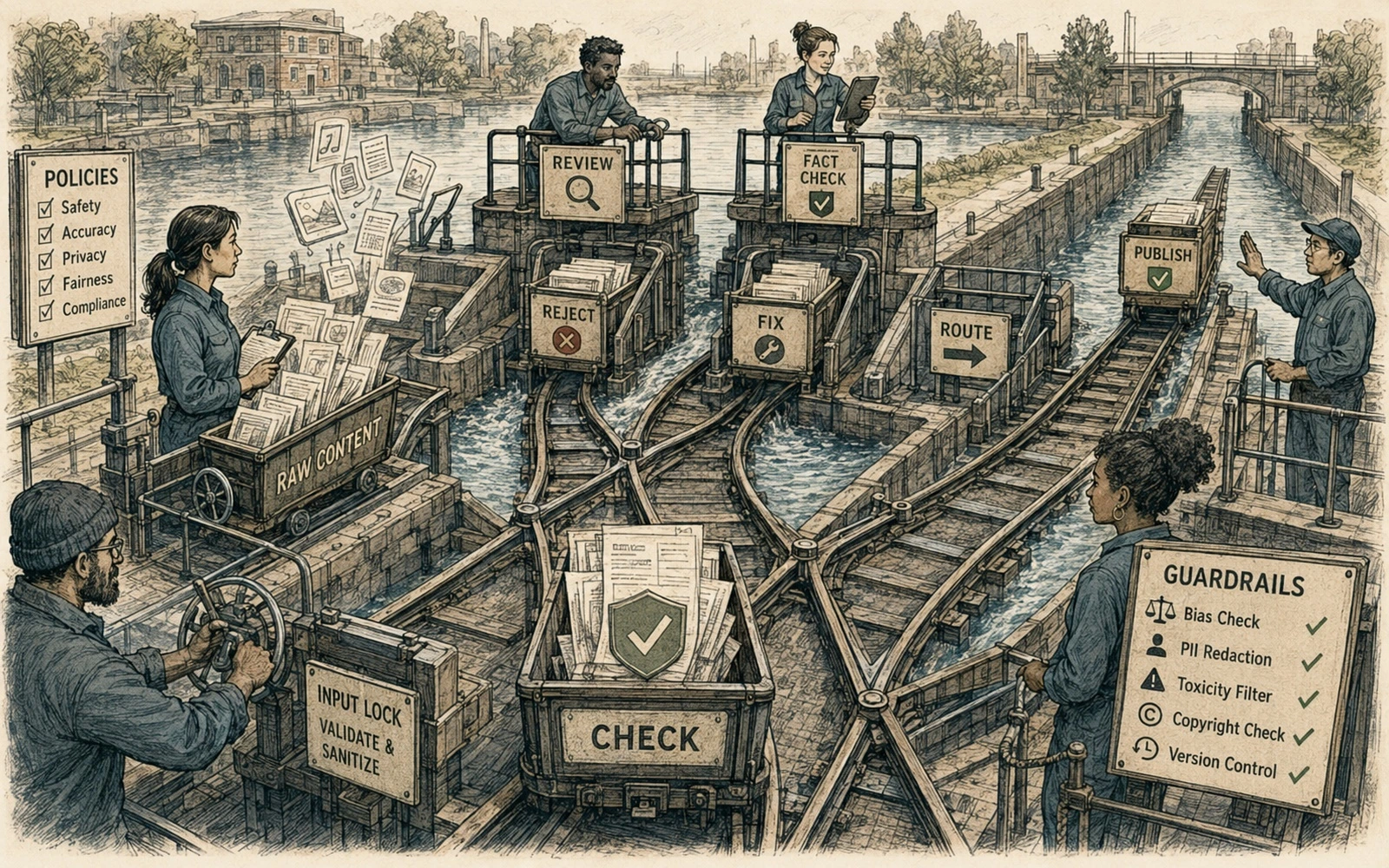
A useful architecture assumes the model will sometimes be wrong. Let it propose files, metadata and edits, but do not let the same step silently publish them. A separate build and review boundary makes failures observable and reversible.
The larger the batch, the more important that boundary becomes.
Constrain the input set
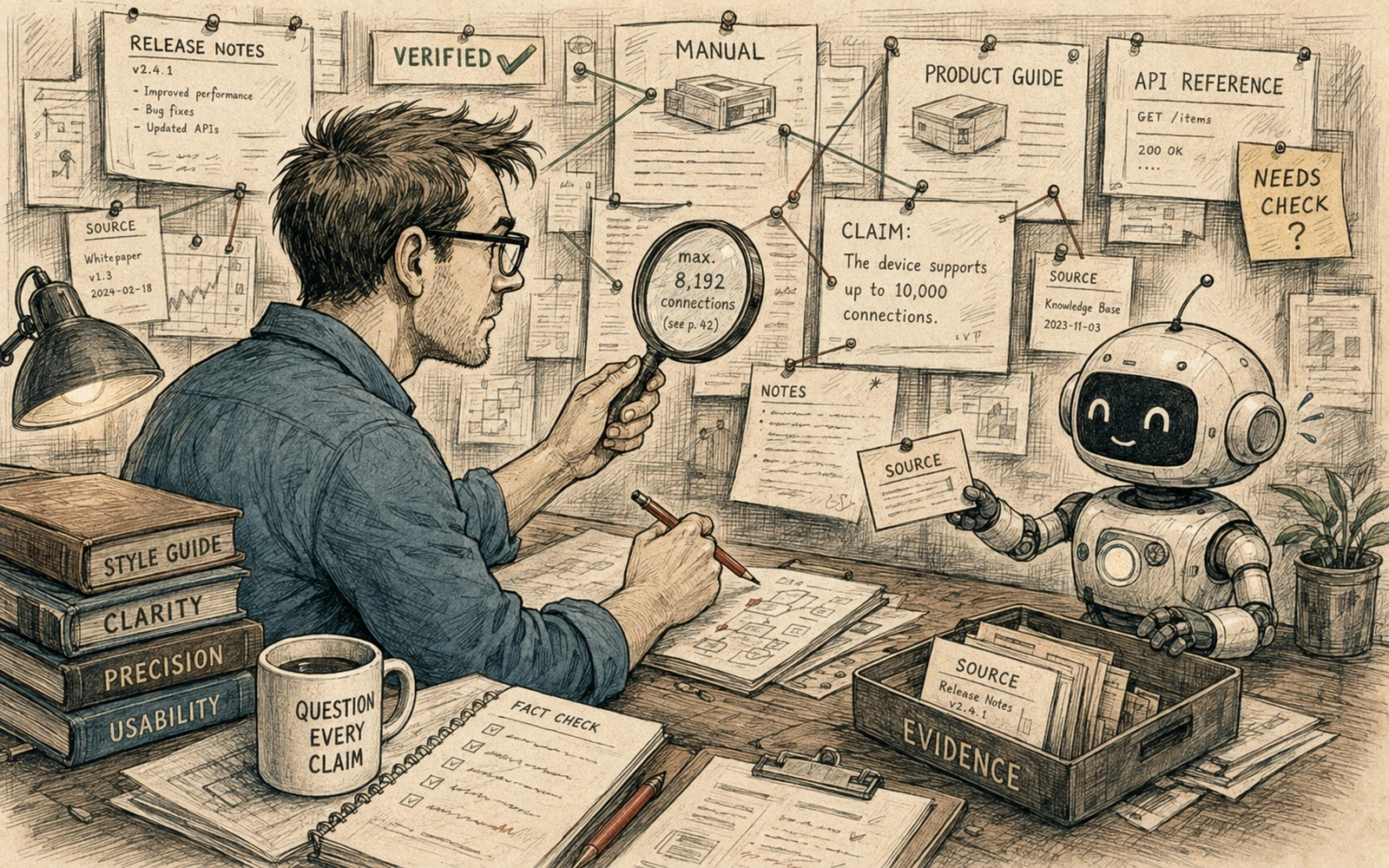
Feed the model named sources rather than an unbounded pile of context. Separate authoritative product facts from examples, historical discussion and user-generated material. Record which source files or API responses were used for a generated revision.
This improves both reproducibility and review: a reviewer can inspect the evidence instead of guessing what the model may have seen.
Validate structure deterministically
Use schemas for frontmatter, controlled vocabularies for tags and terminology, and parsers for code blocks. Check internal links, image references, localization completeness and metadata before any language-model review.
Deterministic checks should fail fast. Do not spend model tokens deciding whether a required field exists.
Treat external text as untrusted input
Imported issues, forum posts, web pages and customer messages can contain instructions that are irrelevant or hostile to the publishing workflow. Extract information from them; do not let their text redefine the agent’s rules or publication policy.
Keep system instructions and repository policy outside content supplied by untrusted sources.
Require evidence for risky claims
Security behavior, limits, compatibility, billing, data handling and destructive procedures need stronger review. Route these changes to an owner even when the prose itself looks excellent.
The safest pipeline is intentionally asymmetric: generating a draft is easy; proving that it may be published is harder.
Preserve rollback
Every automated change should be a normal version-controlled revision with a clear diff. Avoid pipelines that mutate published content without a commit or traceable artifact.
Automation is valuable when it increases throughput without reducing accountability. Guardrails are what make those two goals compatible.
Applied example
Test “Guardrails for an LLM content pipeline that publishes technical docs” with a controlled sample before turning it into a production workflow. Select ten short pieces of documentation whose correct state you already know: some accurate, some outdated, some ambiguous and some intentionally misleading. Give the AI only the information it is supposed to use, keep the instructions fixed, and record both correct decisions and confident mistakes.
Review the result with an editor’s checklist:
- Did the model distinguish evidence from inference?
- Did it preserve terminology and product constraints?
- Did it invent missing facts or soften uncertainty?
- Can a human reviewer see what changed and why?
The useful question is not whether the model can produce fluent prose. It is whether the workflow makes errors visible before publication. Automation earns trust when its boundaries, inputs and review points are explicit enough that a second person can reproduce the decision.
Quick editorial checklist
- Generation and publication are different privileges. A useful architecture assumes the model will sometimes be wrong.
- Constrain the input set. Feed the model named sources rather than an unbounded pile of context.
- Validate structure deterministically. Use schemas for frontmatter, controlled vocabularies for tags and terminology, and parsers for code blocks.
- Treat external text as untrusted input. Imported issues, forum posts, web pages and customer messages can contain instructions that are irrelevant or hostile to the publishing workflow.