The main problem: text is no longer scarce
Three years ago, conversations about AI in technical documentation usually started with one question: “Can a model write instructions as well as a person?” In 2026 that question is almost uninteresting. Yes, it can. With decent inputs, a model can quickly produce reference pages, guide drafts, release notes, API examples, FAQs, parameter descriptions, and alternate wording.
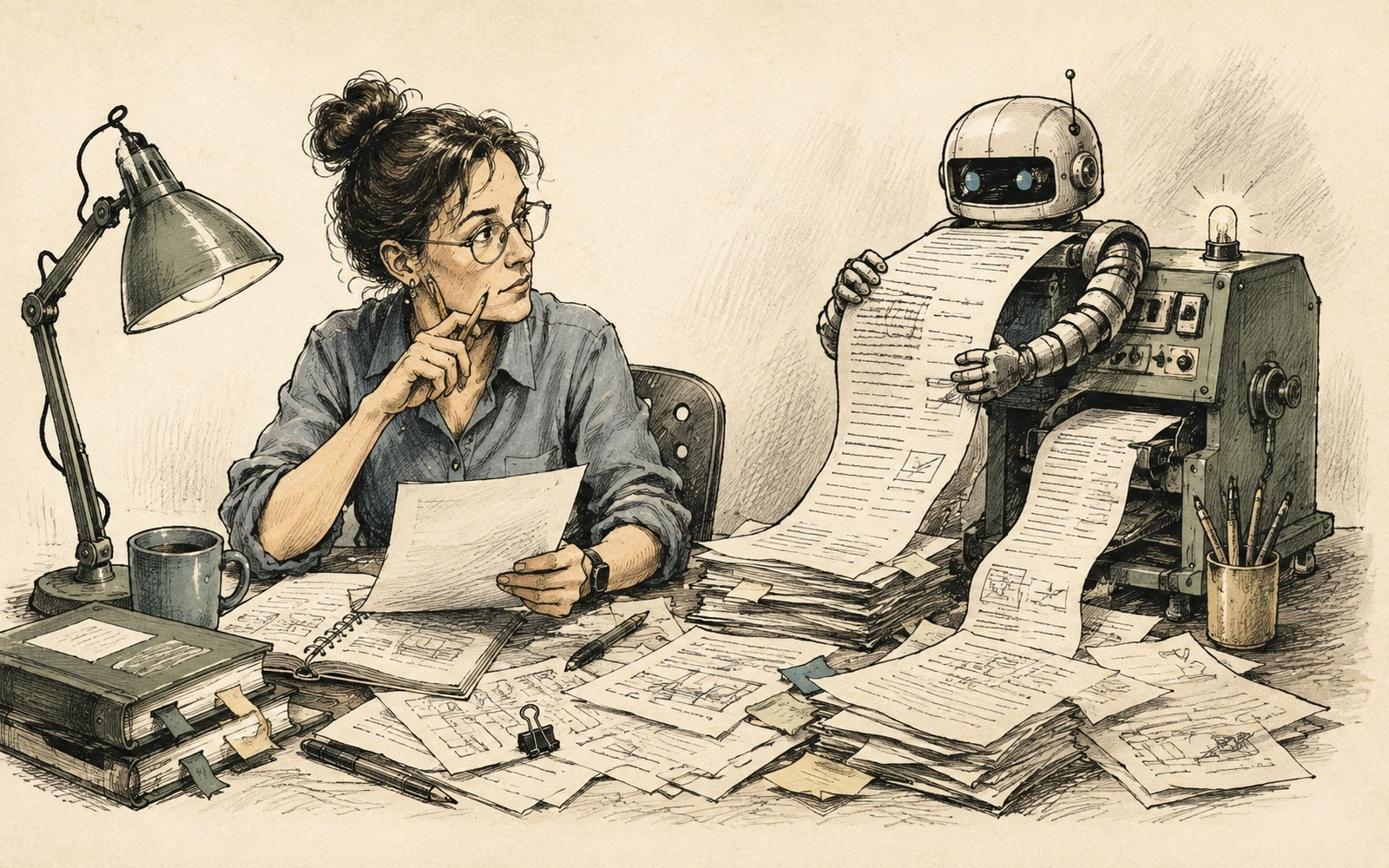
The real problem appeared after writing became cheap. We discovered that prose had only been the visible part of the job. The invisible work is finding out what the product actually does, which constraints apply, which version is supported, which scenario is correct, what changed, who confirms the fact, and how an outdated page is prevented from surviving for another six months.
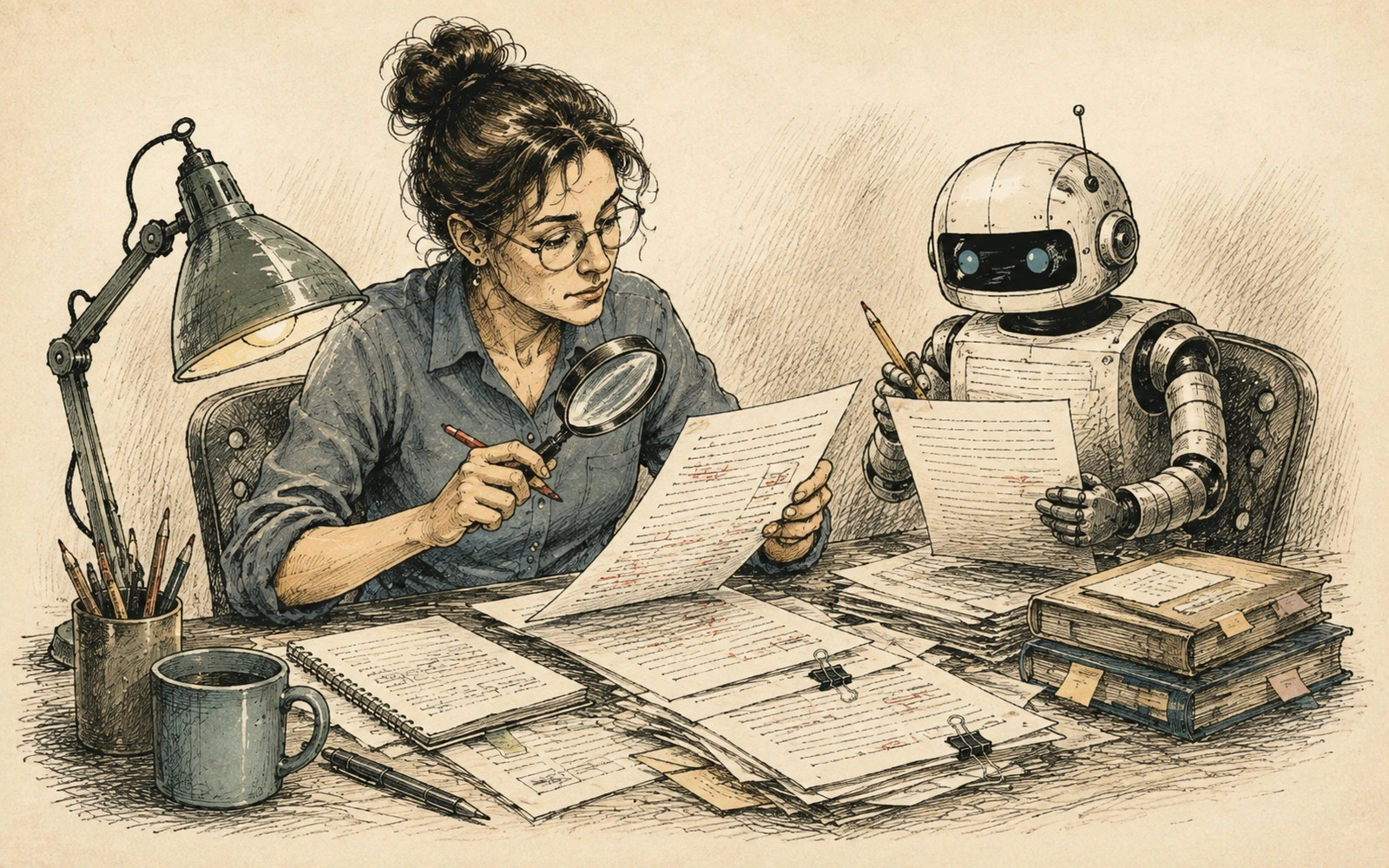
AI therefore creates two opposite effects at once: it makes a technical writer look unnecessary, while making trustworthy documentation harder to govern. Producing one hundred pages is easier. Making those one hundred pages reliable is not.
What actually changed in three years
Since late 2022, language models have moved from interesting paragraph generators to tools that can be embedded in a documentation pipeline. They can:
- turn structured inputs into coherent drafts;
- rewrite material for a different audience or level of expertise;
- normalize terminology and style;
- extract candidate changes from diffs, issues, and release descriptions;
- generate example variants and test scenarios;
- translate and localize large amounts of content;
- classify and connect existing material;
- flag contradictions, gaps, and suspicious claims when enough context is available.
This is not merely faster typing. It changes the economics of documentation production. Work that once took hours can become minutes of preparing evidence followed by minutes of review.
The old excuse “we do not have time to write documentation” becomes less convincing. The writing is cheaper. Evidence collection, decisions, verification, and maintenance remain.
I already know companies that removed technical writers entirely
I personally know several companies that have stopped employing technical writers altogether. This is not a statistical study and it does not prove that the entire profession is disappearing. It does show that a scenario that recently looked theoretical is now economically possible.
The logic is straightforward: a developer or product manager gives source material to a model, AI creates the text, somebody scans it quickly, and the page ships. For a small documentation set, a relatively simple product, and a low cost of error, that process can look convincing for quite a while.
The problems tend to appear later: hundreds of pages diverge, versions drift, one term means three things, old pages keep ranking in search, examples stop working, and nobody knows who owns the integrity of the system.
So the professional question is harsher now. It is not “can AI replace the person who writes paragraphs?” It is “does the company have documentation work that requires a specialist beyond paragraph production?”
If the answer is no, some jobs really will disappear.
The tasks that automate first
The more mechanical and verifiable a task is, the easier it is to delegate to a model or generator.
| Task | Automation potential | What still needs verification |
|---|---|---|
| First draft from a specification | High | Input completeness and facts |
| API parameter descriptions | High | Semantics, constraints, real examples |
| Release notes from a change list | High | What actually matters to users |
| Translation and localization | High | Terminology, product UI, context |
| Rewriting to match a style guide | High | Meaning and technical accuracy |
| FAQ from known support cases | Medium/high | Currency and safety of the solution |
| Architecture of a large docs set | Medium | User tasks and relationships between content |
| Determining actual product behavior | Low | Requires a source of truth and an expert |
| Deciding what deserves documentation | Low | Requires product context and priorities |
| Ownership of a published claim | Not automatable | A responsible owner is required |
Automation grows fastest where correctness can be checked by a machine. Human work remains where reality has to be understood before prose can be produced.
What the documentation workflow looks like now
The old workflow was often linear: an expert explained, a technical writer wrote, an expert reviewed, and the team published.
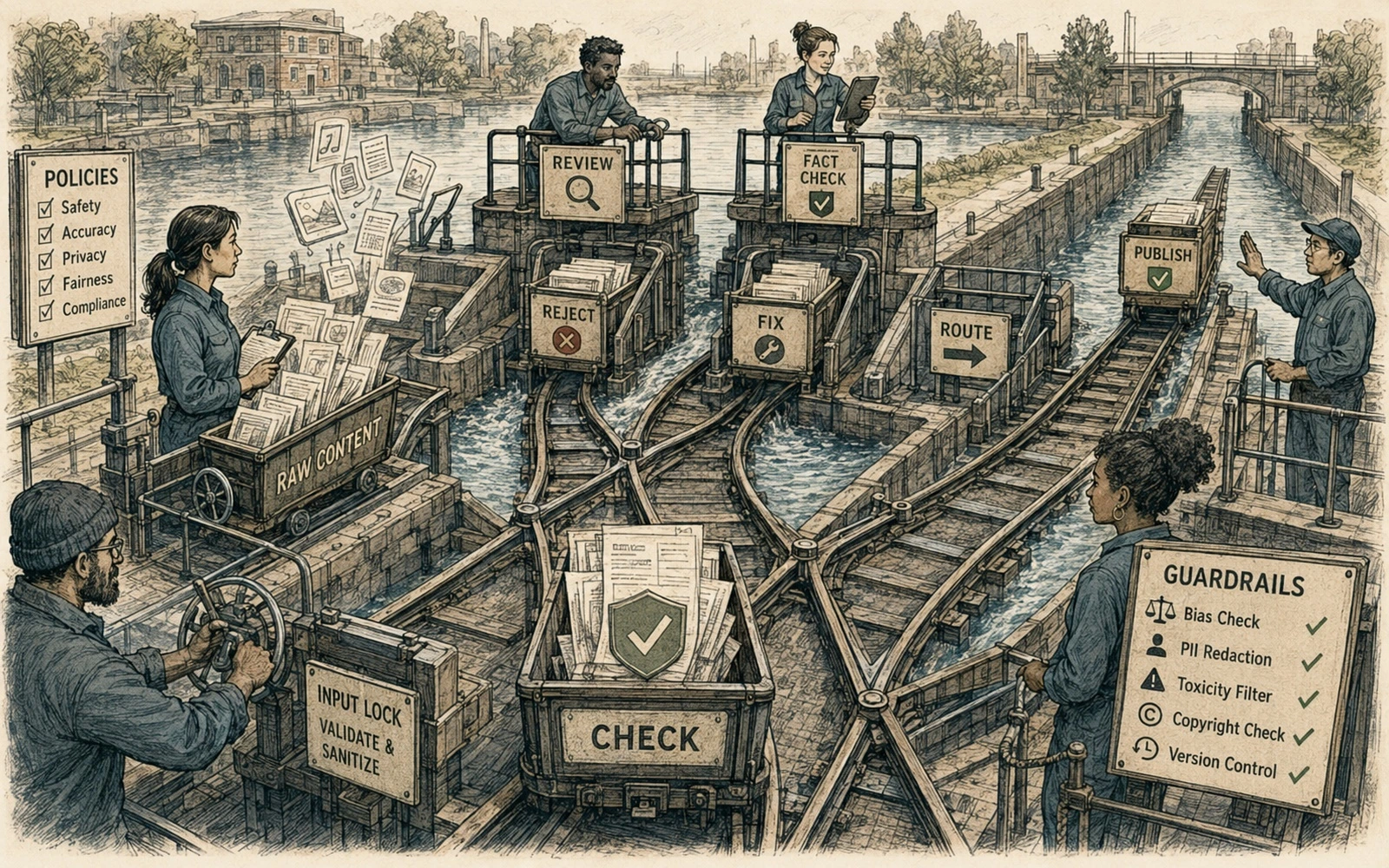
A modern workflow looks more like an engineering pipeline:
The important change is that AI is not placed at the end as “the author.” It sits inside the system between evidence and accountable people.
Who owns what now
Writing “AI verifies the documentation” in a process document is dangerous. A model can flag a contradiction, but it cannot become the owner of a fact. Responsibilities need to be explicit.
| Stage | AI | Technical writer | SME / product team |
|---|---|---|---|
| Gather inputs | Classifies and summarizes | Identifies missing evidence | Provides the source of truth |
| Structure | Proposes options | Chooses architecture and user path | Confirms product constraints |
| Draft | Generates | Sets rules and edits | Resolves ambiguity |
| Examples | Proposes | Checks usefulness and completeness | Runs or validates technically |
| Facts | Flags suspicious claims | Connects claims to evidence | Confirms behavior |
| Style | Performs automated checks | Makes editorial decisions | Usually not involved |
| Publication | Does not approve | Controls readiness | Approves critical changes |
| Maintenance | Finds stale candidates | Manages update backlog | Confirms product changes |
If nobody in your organization can fill these cells with actual names or roles, responsibility is simply diffused.
How I would build a technical writer’s workflow now
Start with evidence, not a prompt
Before generation, create an evidence pack. For an API, that might mean OpenAPI, real requests and responses, tested data, error behavior, and authorization constraints. For UI, use acceptance criteria, current screens, supported states, and verified scenarios. For hardware, use specifications, test results, and safety requirements.
A clever prompt cannot repair bad input. It only makes uncertainty sound more convincing.
Ask AI to analyze before it writes
First ask what entities and states are present, where sources conflict, what information is missing, and which claims need confirmation. Only then ask for prose.
This makes the model an analytical layer rather than an automatic typewriter.
Generate small, verifiable units
Do not ask for “the full product manual.” Ask for “the authorization section using only these sources,” “a table of error codes,” or “three introductions with no new facts.”
Smaller generation units make mistakes easier to find and provenance easier to track.
Review evidence, not fluency
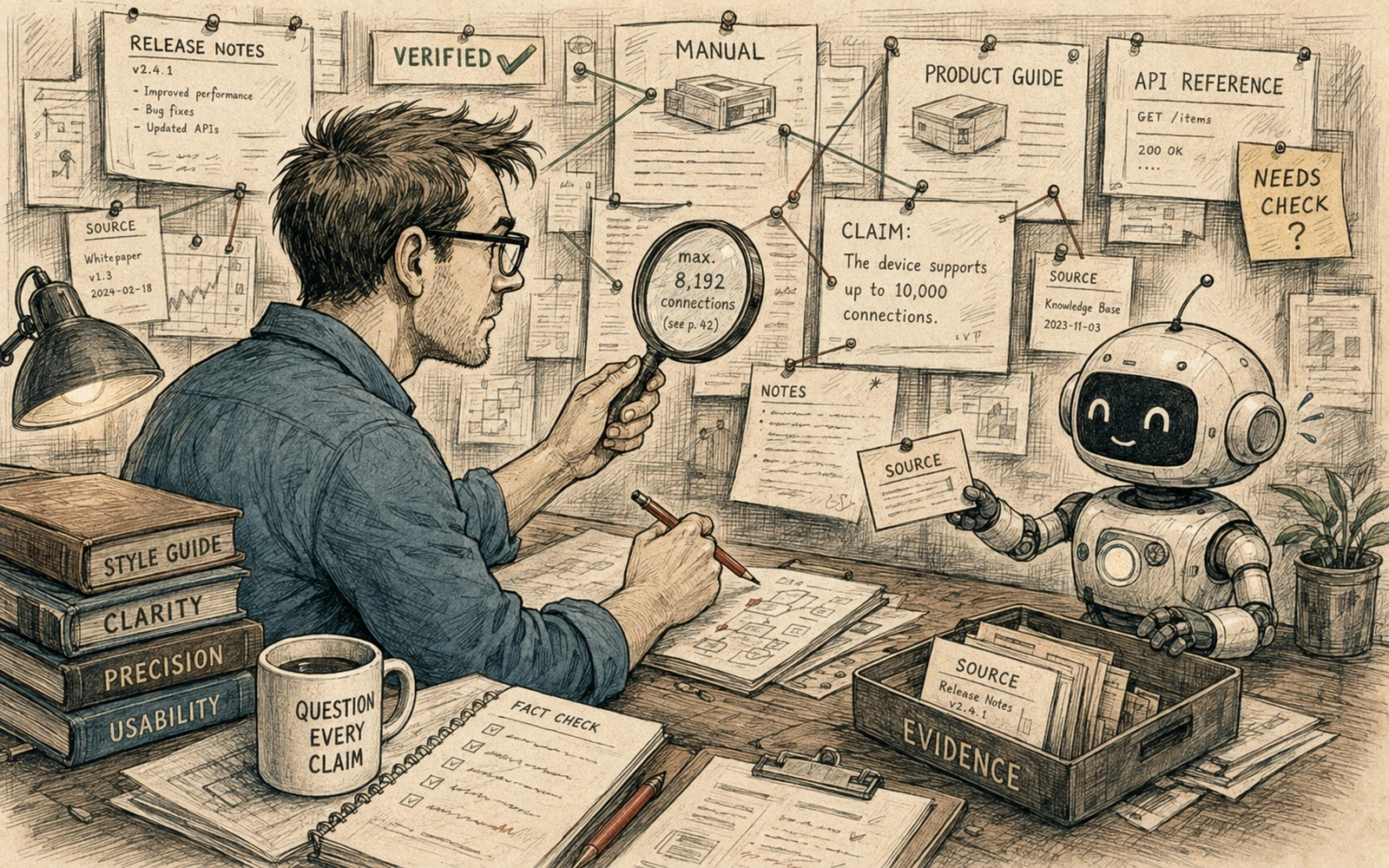
For every important claim, the reviewer should know where it came from. Ideally, reviewers see not only a polished paragraph but the related diff, ticket, specification, test, or SME confirmation.
Fluent language is no longer evidence of quality. A model can sound equally confident when correct or wrong.
Automate deterministic checks
Links, builds, terminology, required sections, metadata structure, example formats, linting, duplication, and schema compliance should move into automated checks. Do not spend human attention on something a deterministic tool can validate.
Keep high-cost decisions human-owned
Safety, legal commitments, data migrations, compatibility promises, irreversible actions, product limitations, and ambiguous scenarios need an accountable person.
Review needs three layers now
One person reading a page and saying “looks fine” is a weak control model.
Is it understandable? Is the order right? What should be removed? Does the page solve the user’s task?
Are the facts, commands, states, constraints, and examples correct for the current product?
Does the site build? Are links alive? Is terminology consistent? Do examples and quality rules pass?
AI can assist in all three layers, but it should not silently become the owner of any of them.
Why “AI checked the AI” is not fact-checking
Asking a second model to critique the first is useful for finding suspicious statements. It is not confirmation. Both models can share the same bad assumption or fill the same missing information with equally plausible fiction.
A stronger pattern is:
Retrieval and internal knowledge systems are valuable because they reduce the space in which the model has to invent. Retrieved text still needs interpretation: it may be stale, version-specific, or describing an exception.
What if the company has already eliminated technical writers?
Documentation written by developers with AI is not automatically a disaster. But somebody still has to perform the functions that a documentation team used to own.
At minimum:
- assign a documentation owner for every product or domain;
- define sources of truth;
- require technical review for critical material;
- automatically check builds, links, terminology, and structure;
- keep a visible backlog of stale and disputed pages;
- collect user feedback;
- regularly delete or rewrite material instead of only adding more.
If nobody owns these tasks, the organization has not “automated technical writers.” It has simply stopped governing documentation.
The new role of the technical writer
I do not think the profession can be defended with “humans still write nicer prose.” Sometimes they do. Sometimes the model does. That is too weak a boundary.
A stronger boundary is ownership of the information product. A modern technical writer can be the person who:
- designs knowledge architecture;
- defines sources of truth;
- converts product change into a controlled documentation backlog;
- designs generation and review rules;
- creates automated quality gates;
- validates examples and user scenarios;
- manages terminology and reuse;
- connects docs to support, product, engineering, and feedback;
- decides when a page must be updated, merged, or deleted;
- owns reliability rather than word count.
The job title may remain Technical Writer. It may become Documentation Engineer, Content Engineer, Knowledge Engineer, or Docs Lead. The title matters less than where accountability lives.
The skills that become more valuable
Product understanding
The easier prose becomes to generate, the more valuable the person who understands the system, asks good questions, and detects undocumented states becomes.
Information architecture
AI can generate a year’s worth of content chaos in a day. Someone must control page count, navigation, duplication, and lifecycle.
APIs, data, and automation
Structured sources are ideal automation inputs. Writers who understand APIs, schemas, Git, CI, and quality automation can manage the pipeline instead of competing with it on typing speed.
Editorial judgment
When every draft looks professional, editing becomes the work of deciding what matters: what to remove, what comes first, which example is necessary, what is missing, and where a user is likely to fail.
Fact verification
Verification becomes an engineering discipline of its own: claim provenance, source version, executable examples, and traceability from product change to published content.
What to measure instead of page count
When AI can multiply output, published-page count becomes even less useful.
Measure things such as:
- user tasks completed without a support request;
- critical examples covered by automated tests;
- pages with a known owner;
- content past its review date;
- errors caught before publication rather than by users;
- time from product change to documentation update;
- unused pages that can be removed;
- important claims traceable to a current source.
A small documentation team in 2026
For a product that once had several writers, I would rather build a compact system around a strong documentation specialist than preserve a manual writing factory:
This model does not guarantee that writer headcount stays the same. It probably will not. But the person designing and controlling the information system has broader responsibility than before.
What a technical writer should do personally
If your main value is “give me a task and I will write polished text,” the risk is high now, not ten years from now.
A practical plan is more specific than “learn AI”:
- Learn to extract evidence from the product, not only interviews.
- Become comfortable with APIs, Git, and basic automation.
- Learn to architect large documentation sets.
- Design review processes and quality gates.
- Use AI daily and record where it fails.
- Learn claim provenance and evidence-based fact review.
- Own the user outcome, not prose as an end in itself.
Conclusion: AI did not eliminate documentation; it eliminated the monopoly on producing prose
In 2026 it is pointless to argue that AI “cannot write documentation.” It can. Sometimes well enough that a company decides it no longer needs a dedicated writer.
But documentation is not a pile of paragraphs. It is a contract between product and user about what exists, how it behaves, where its limits are, and what can be trusted.
If the technical writer role was only paragraph production, it will shrink. If the role includes product research, knowledge architecture, evidence management, review, quality automation, and lifecycle ownership, then we are seeing a redesign of the job rather than the end of the work.
The goal is not to write faster than AI. That is neither possible nor useful. The goal is to build a system in which AI can write quickly without allowing mistakes to reach users just as quickly.