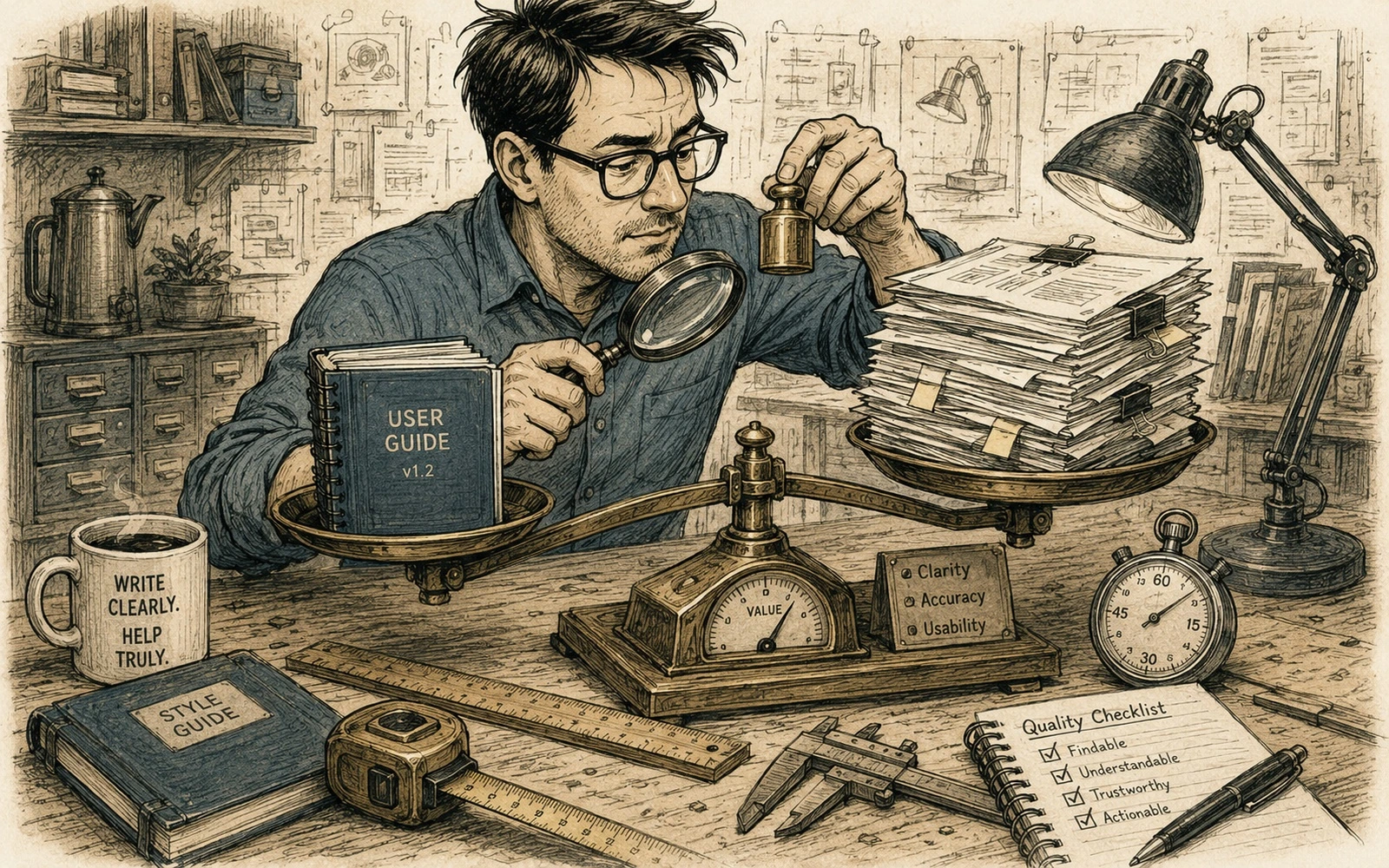
A matrix is a map, not a scorecard
Teams often build a skills matrix when hiring becomes inconsistent or promotion conversations become subjective. The temptation is to create dozens of rows and assign levels from one to five. That looks rigorous, but numbers do not help if nobody can explain what evidence separates level three from level four.
Start with capabilities that produce observable work: research, writing and editing, information architecture, API literacy, tooling, release coordination, quality automation and stakeholder management.
Describe scope and independence
For each capability, describe the kind of problem a person can handle and how independently they can handle it. A junior writer may update an established procedure with review. A more experienced writer may discover the workflow, validate it with engineers, design the structure and create the review process for future changes.
This is more useful than adjectives such as “excellent communicator” because managers can point to actual artifacts and decisions.
Separate craft from domain knowledge
Do not encode one product’s stack as the definition of seniority. Knowing Kubernetes can be important for one role and irrelevant for another. Keep durable documentation skills separate from local domain expertise, then add role-specific expectations where necessary.
The same applies to tools. Git competence may be required in a Docs-as-Code team, but knowing a particular static-site generator is usually evidence of tool familiarity, not a career level by itself.
Use the matrix in both directions
A matrix should help a manager explain expectations, but it should also help a writer choose the next skill to practice. Add examples of evidence: a redesigned navigation system, an API reference with tested examples, a terminology migration, a CI quality gate, or a cross-team documentation plan.
During hiring, evaluate only the capabilities that matter for the role. During development, choose a few growth targets rather than asking everyone to maximize every row.
Review the matrix when the work changes
AI-assisted drafting, structured content and documentation engineering are changing which activities consume time. Update the matrix when the job changes, not when a new buzzword appears. The durable question is always the same: what valuable documentation problem can this person own reliably?
Applied example
Use “Build a technical writer skills matrix that measures useful work” as a team exercise rather than a statement about job titles. Pick one recent documentation task and reconstruct who made each important decision: who discovered the user need, who found the technical facts, who designed the structure, who reviewed it, and who will own the next revision. This usually reveals that the profession is defined less by a fixed list of tools than by the decisions a person can make reliably.
Then compare the task with the capability you actually want to develop or hire for. Ask the team to describe observable evidence instead of personality labels:
- What problem can the person own without step-by-step supervision?
- Which stakeholders can they interview and challenge constructively?
- What quality risks can they detect before publication?
- What documentation system or process can they improve, not merely use?
A useful professional model should help a person choose the next difficult problem to practice. If it only produces labels such as “junior”, “senior”, “good communicator” or “tool expert”, it is too vague to guide growth or hiring.
Quick editorial checklist
- A matrix is a map, not a scorecard. Teams often build a skills matrix when hiring becomes inconsistent or promotion conversations become subjective.
- Describe scope and independence. For each capability, describe the kind of problem a person can handle and how independently they can handle it.
- Separate craft from domain knowledge. Do not encode one product’s stack as the definition of seniority.
- Use the matrix in both directions. A matrix should help a manager explain expectations, but it should also help a writer choose the next skill to practice.