Leadership is a system design problem
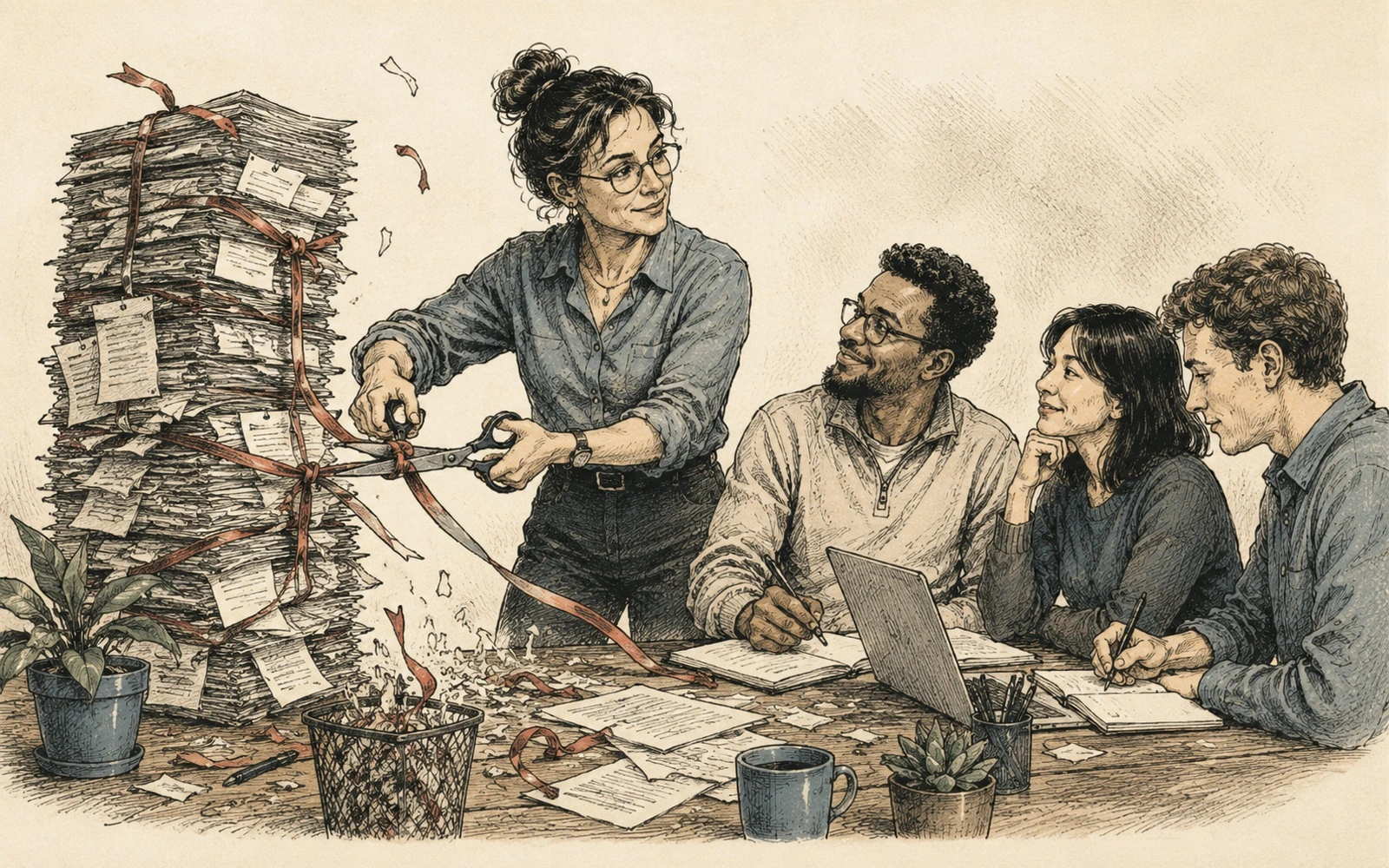
When documentation grows across several teams, somebody eventually asks for central control. The wrong response is to make every change pass through one senior editor. That produces a queue, hides product ownership and turns the documentation lead into a human merge conflict.
The useful job is to design rules that let routine work move without central intervention while making risky work easy to identify.
Make ownership explicit
Every area needs a technical owner and an editorial path. Ownership can be encoded in repository rules, metadata or team agreements, but it should be visible. A writer should know who can confirm behavior; an engineer should know who maintains the explanation.
Reserve mandatory central review for changes with cross-product impact, legal or safety implications, shared terminology or major information-architecture changes.
Standardize interfaces, not every sentence
A lead should define content types, metadata, terminology rules, quality gates and reusable components. Those are interfaces between contributors. They create consistency without forcing every page to sound identical.
Avoid a style guide full of preferences that cannot be automated or explained. If a rule matters, say what problem it prevents and, where possible, encode it in templates, schemas or linting.
Build escalation paths
Most documentation conflicts are not grammar disputes. They are unresolved product questions: which behavior is supported, who owns an endpoint, whether a feature is deprecated, or what promise the company is willing to make. Define where those questions go and how decisions are recorded.
A documentation lead adds leverage when the same uncertainty is solved once and the answer becomes reusable.
Measure flow and risk
Look at review time, stale content, failed examples, broken links, search failures and release mismatches. Do not optimize for the number of pages published. A smaller, trustworthy documentation set can be healthier than a rapidly growing archive nobody owns.
Good documentation leadership makes the organization less dependent on the lead. The system should keep working when that person is on vacation.
Applied example
Use “Documentation leadership without building a bureaucracy” as a team exercise rather than a statement about job titles. Pick one recent documentation task and reconstruct who made each important decision: who discovered the user need, who found the technical facts, who designed the structure, who reviewed it, and who will own the next revision. This usually reveals that the profession is defined less by a fixed list of tools than by the decisions a person can make reliably.
Then compare the task with the capability you actually want to develop or hire for. Ask the team to describe observable evidence instead of personality labels:
- What problem can the person own without step-by-step supervision?
- Which stakeholders can they interview and challenge constructively?
- What quality risks can they detect before publication?
- What documentation system or process can they improve, not merely use?
A useful professional model should help a person choose the next difficult problem to practice. If it only produces labels such as “junior”, “senior”, “good communicator” or “tool expert”, it is too vague to guide growth or hiring.
Quick editorial checklist
- Leadership is a system design problem. When documentation grows across several teams, somebody eventually asks for central control.
- Make ownership explicit. Every area needs a technical owner and an editorial path.
- Standardize interfaces, not every sentence. A lead should define content types, metadata, terminology rules, quality gates and reusable components.
- Build escalation paths. Most documentation conflicts are not grammar disputes.