Define the problem
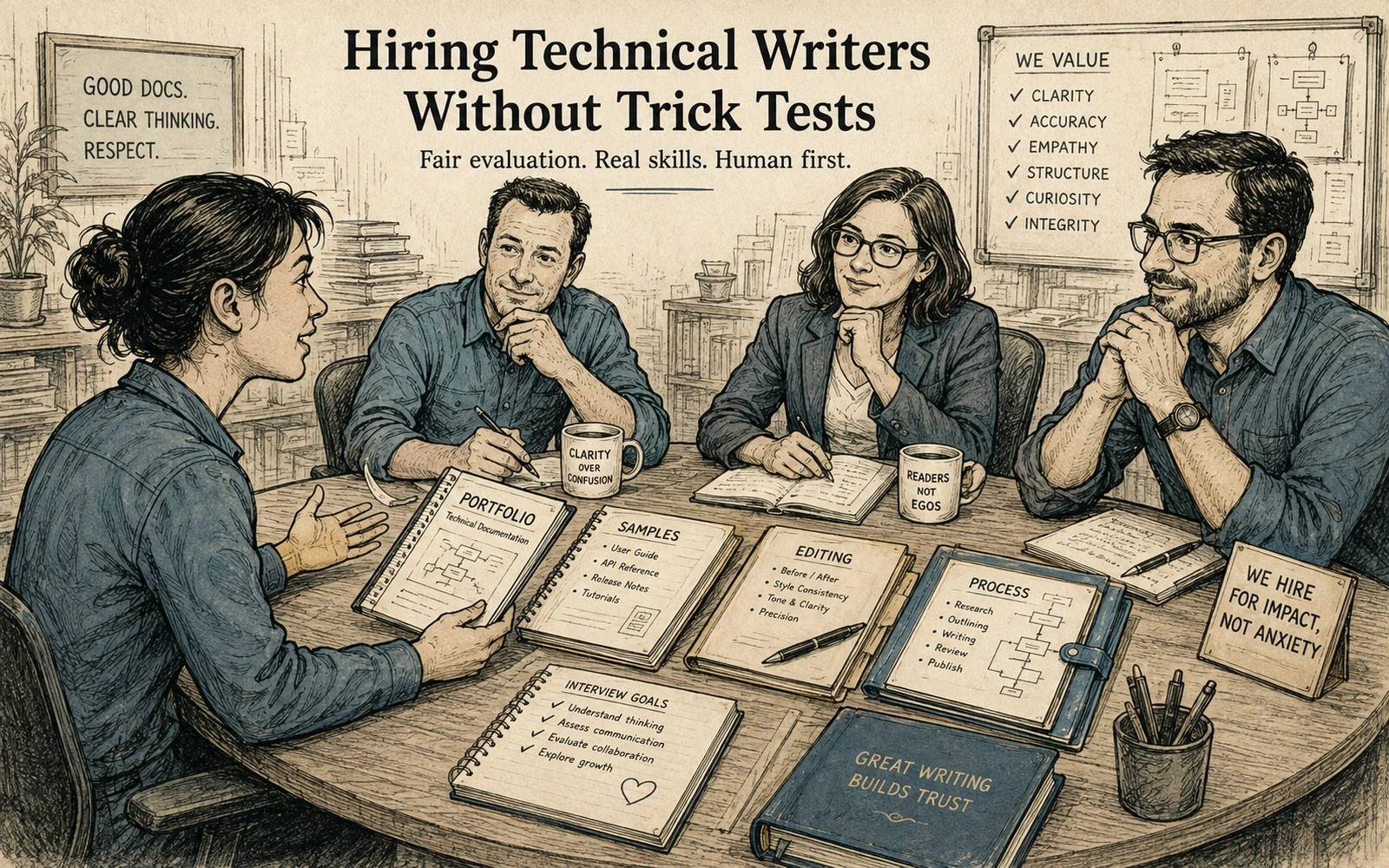
Test the work the role actually requires instead of grammar puzzles and obscure trivia. A hiring exercise should reveal how a candidate discovers missing information, structures a task and edits ambiguous source material.
Choose a useful model
Keep take-home assignments bounded, timeboxed and identical in brief for every candidate. Use a small realistic sample with enough context to reason about; hidden requirements mostly measure guessing and unpaid time.
Build the workflow
Ask what the candidate would verify, what is ambiguous and which questions they would send to an expert. Ask candidates to explain their editorial choices so reviewers can distinguish deliberate trade-offs from accidental formatting.
Check the result
Review the reasoning behind edits, not only the polished final output. Score against a published rubric covering correctness, reader focus, structure, questions raised and clarity rather than personal taste.
Keep it maintainable
Make the process predictable and respectful; hiring itself demonstrates the organization’s information culture. Keep the exercise short and comparable across candidates, and do not ask applicants to produce work the company could ship as free labor.
Applied example
Use “Hiring technical writers without trick tests” as a team exercise rather than a statement about job titles. Pick one recent documentation task and reconstruct who made each important decision: who discovered the user need, who found the technical facts, who designed the structure, who reviewed it, and who will own the next revision. This usually reveals that the profession is defined less by a fixed list of tools than by the decisions a person can make reliably.
Then compare the task with the capability you actually want to develop or hire for. Ask the team to describe observable evidence instead of personality labels:
- What problem can the person own without step-by-step supervision?
- Which stakeholders can they interview and challenge constructively?
- What quality risks can they detect before publication?
- What documentation system or process can they improve, not merely use?
A useful professional model should help a person choose the next difficult problem to practice. If it only produces labels such as “junior”, “senior”, “good communicator” or “tool expert”, it is too vague to guide growth or hiring.
Quick editorial checklist
- Define the problem. Test the work the role actually requires instead of grammar puzzles and obscure trivia.
- Choose a useful model. Keep take-home assignments bounded, timeboxed and identical in brief for every candidate.
- Build the workflow. Ask what the candidate would verify, what is ambiguous and which questions they would send to an expert.
- Check the result. Review the reasoning behind edits, not only the polished final output.