“Who owns this page?”
The tooling answer changed from shared folders to repositories and ownership files, but the organizational question did not. A page without a responsible product owner eventually becomes a guess about current behavior.
Modern systems can expose ownership more clearly; they cannot invent it.
“Should we duplicate or reuse this text?”
Reuse still trades consistency against context. A shared warning is valuable when its meaning and lifecycle are truly shared. Reusing a paragraph merely because the words look similar can make both pages harder to understand.
The right unit of reuse is semantic, not visual.
“How many screenshots are too many?”
Screenshots remain expensive when interfaces change, difficult to localize and sometimes poor for accessibility. They are still excellent when spatial orientation matters. The durable rule is to use an image when it communicates something the text would communicate worse, then keep the essential instruction in text as well.
“Who should review documentation?”
The answer is still plural. Technical truth, editorial quality and product policy may require different reviewers. A single approval checkbox cannot prove all three.
Modern pull-request workflows make those responsibilities easier to route, but teams still need to define them.
“Which tool should we choose?”
This question survives every generation because tool choice is really a question about content, contributors and maintenance. Requirements first, prototype the hard cases, and keep an exit path.
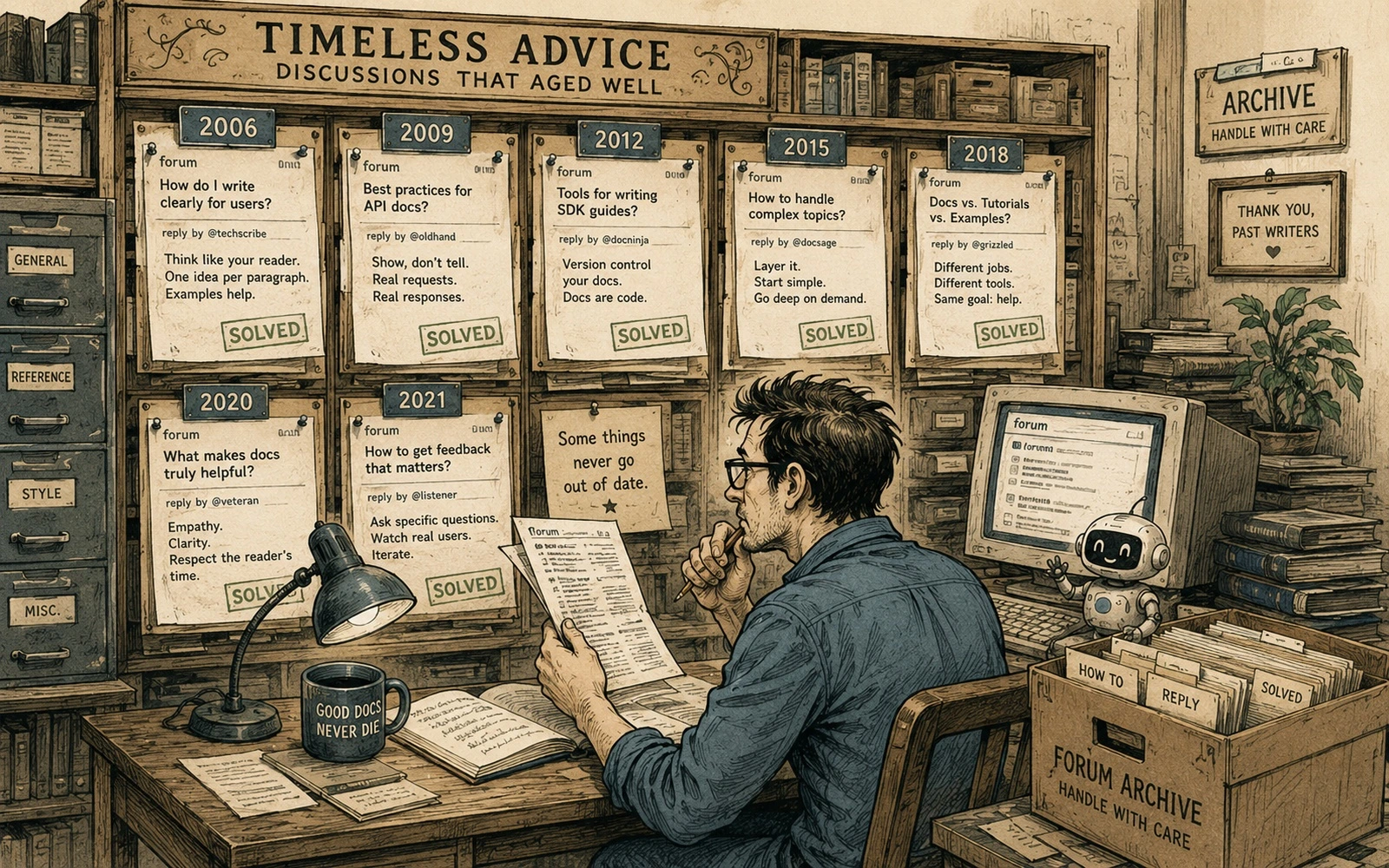
Reading old discussions is useful when it reveals which problems survived several waves of technology. Those are usually the problems worth solving at the system level.
Applied example
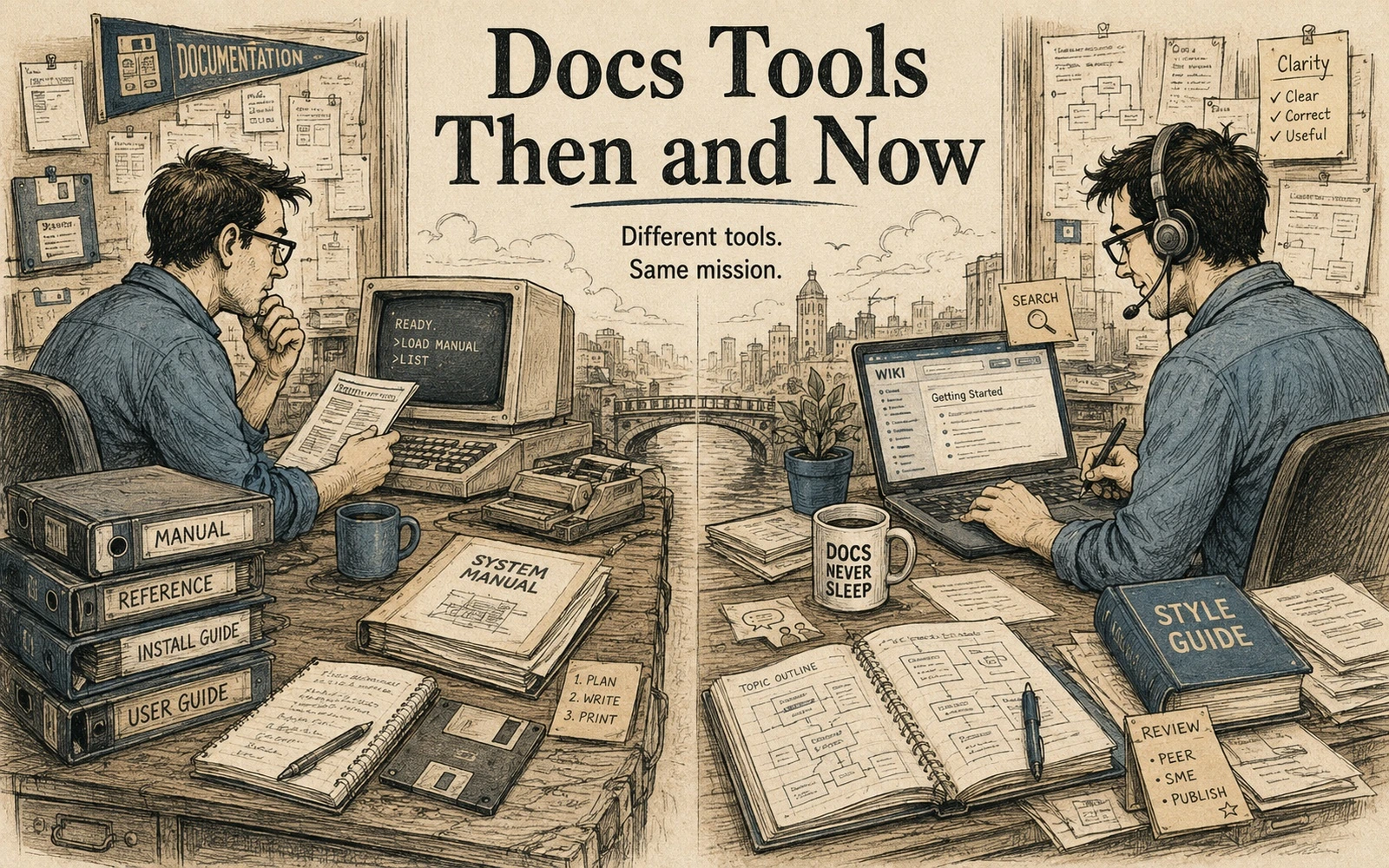
Read “Old documentation questions that aged surprisingly well” in two columns: what belonged to the technology of its time, and what belonged to the underlying documentation problem. Recreate one small historical workflow with current tools—for example, publishing a release note, maintaining a glossary or packaging an offline manual—and mark which decisions stayed the same even though the medium changed.
Look for durable patterns rather than nostalgia:
- How did readers find information?
- How were corrections distributed?
- Who owned accuracy after publication?
- Which limitations of the old medium forced useful discipline?
Historical material becomes valuable when it helps us see a current problem more clearly. The goal is not to restore an old workflow, but to separate enduring editorial principles from tools that happened to be available at the time.
Quick editorial checklist
- “Who owns this page?”. The tooling answer changed from shared folders to repositories and ownership files, but the organizational question did not.
- “Should we duplicate or reuse this text?”. Reuse still trades consistency against context.
- “How many screenshots are too many?”. Screenshots remain expensive when interfaces change, difficult to localize and sometimes poor for accessibility.
- “Who should review documentation?”. The answer is still plural.