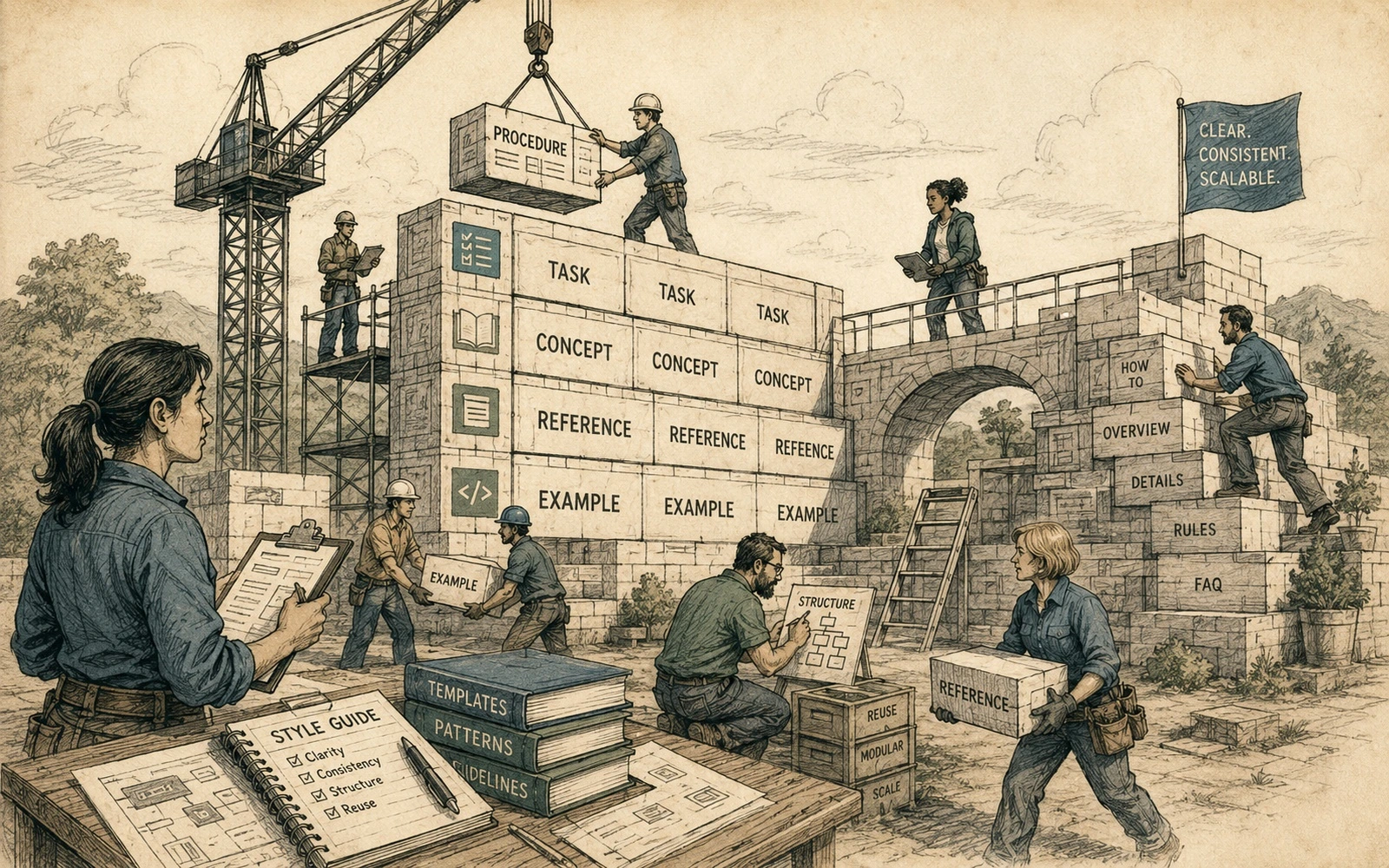
Scale changes how consistency is produced
A small team can rely on shared habits and direct editing. With dozens or hundreds of contributors, memory stops being a control system. Rules need to live in the publishing environment.
Structured writing does not require adopting a specific XML vocabulary. It means deciding which kinds of content exist, what each one must contain and how they can be reused.
Define a small content model
Start with the recurring shapes in your documentation: concept, procedure, API reference, troubleshooting entry, release note. Give each type required metadata and a predictable section order where that order adds value.
Avoid creating a new type for every exception. A content model becomes useful when authors can recognize the patterns quickly.
Centralize terminology
Maintain preferred product names, UI labels and technical terms in one place. Make replacements explicit and explain exceptions. Connect the terminology list to linting where possible so reviewers spend less time catching mechanical drift.
Terminology is part of the user interface. Renaming the same concept across pages is a navigation defect, not merely a style defect.
Turn repeated prose into components carefully
Reuse warnings, prerequisites and shared explanations when the meaning is truly identical. Do not force superficially similar paragraphs into one component if their context or ownership differs.
Every reused fragment needs an owner and a way to preview where it appears.
Keep the style guide short enough to use
Put high-frequency, high-impact decisions in the main guide. Move edge cases into searchable references. Whenever a rule can be enforced by schema, template or linter, prefer the automated path.
The goal is not uniform prose. It is predictable documentation that remains maintainable as the contributor count grows.
Applied example
Apply “Structured writing rules that still work when hundreds of people contribute” to one real page rather than discussing the rule in isolation. Choose a page with enough complexity to expose failure: headings, a table, a note, an example, a term that appears several times, and at least one action the reader must perform. Review the page once as an author and once as a reader who does not know the internal product vocabulary.
Record defects in observable terms:
- Which structure carries meaning that is not available in plain text?
- Which term changes meaning or spelling across the page?
- Which instruction depends on context that is never stated?
- Which rule would be difficult to check consistently in review?
A standard is useful when it helps two editors make roughly the same decision on the same content. If the rule sounds correct but cannot be demonstrated on a representative page, refine the rule, add an example, or narrow its scope before treating it as policy.
Quick editorial checklist
- Scale changes how consistency is produced. A small team can rely on shared habits and direct editing.
- Define a small content model. Start with the recurring shapes in your documentation: concept, procedure, API reference, troubleshooting entry, release note.
- Centralize terminology. Maintain preferred product names, UI labels and technical terms in one place.
- Turn repeated prose into components carefully. Reuse warnings, prerequisites and shared explanations when the meaning is truly identical.