Define the problem
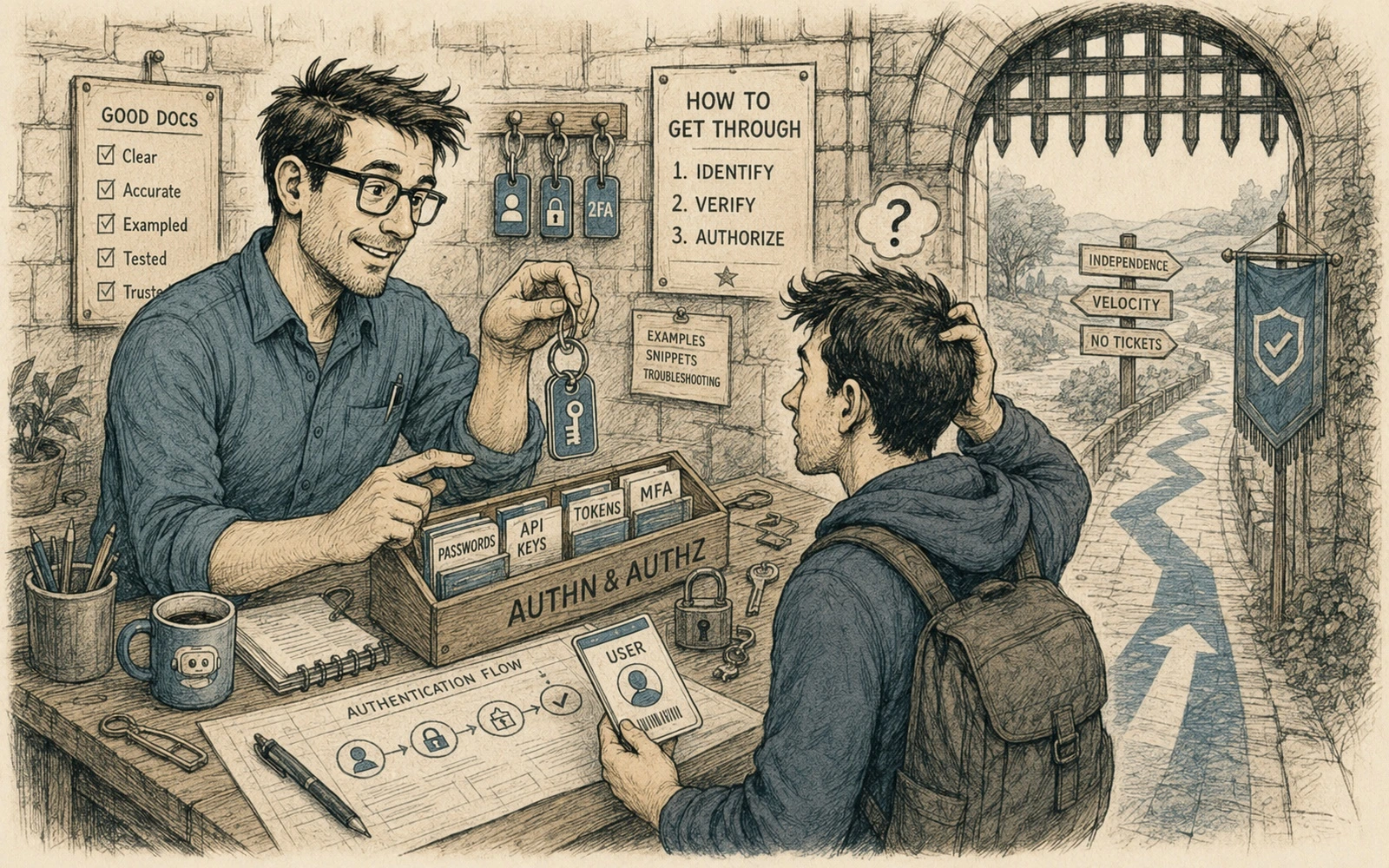
Explain prerequisites, roles, environments and credential issuance before the first HTTP request. Authentication documentation should take a reader from credentials to a verified first request without requiring them to infer security-sensitive steps.
Choose a useful model
Show exactly where credentials go and what header, prefix, signature, cookie or certificate shape is required. State where credentials come from, where they are sent, how environments differ and which values must never be committed to source control.
Build the workflow
Document lifetime and rotation, including whether old and new credentials can overlap safely. Show token lifetime, refresh or rotation behavior and the exact symptoms of expired or insufficient credentials.
Check the result
Separate authentication failures from authorization failures so users do not recreate valid credentials unnecessarily. Include a troubleshooting path that distinguishes malformed credentials, missing permissions, wrong audience and clock or environment mistakes.
Keep it maintainable
Provide a diagnostic order: environment, credential type, transmission, clock or signature requirements, then permissions. Review authentication docs with a clean account periodically; experienced team members often skip the setup detail that causes most support tickets.
Applied example
Turn “Authentication documentation that prevents support tickets” into one complete developer task. Use a fictional but realistic resource, such as a report, device or order, and write the shortest path from authentication to a successful result. Include the request, the important response fields, one likely failure and the next action after that failure. The exercise should be executable in principle even if the article does not depend on a live service.
Check the example as if you were building a client from it:
- Which values must the developer replace?
- Which identifiers are returned by the server and reused later?
- What status or field tells the client that the operation succeeded?
- What should the client do when credentials, input or rate limits fail?
If those answers are scattered across unrelated pages, the documentation may be technically complete but operationally weak. API documentation is successful when a developer can predict the interaction, not merely recognize endpoint names.
Quick editorial checklist
- Define the problem. Explain prerequisites, roles, environments and credential issuance before the first HTTP request.
- Choose a useful model. Show exactly where credentials go and what header, prefix, signature, cookie or certificate shape is required.
- Build the workflow. Document lifetime and rotation, including whether old and new credentials can overlap safely.
- Check the result. Separate authentication failures from authorization failures so users do not recreate valid credentials unnecessarily.