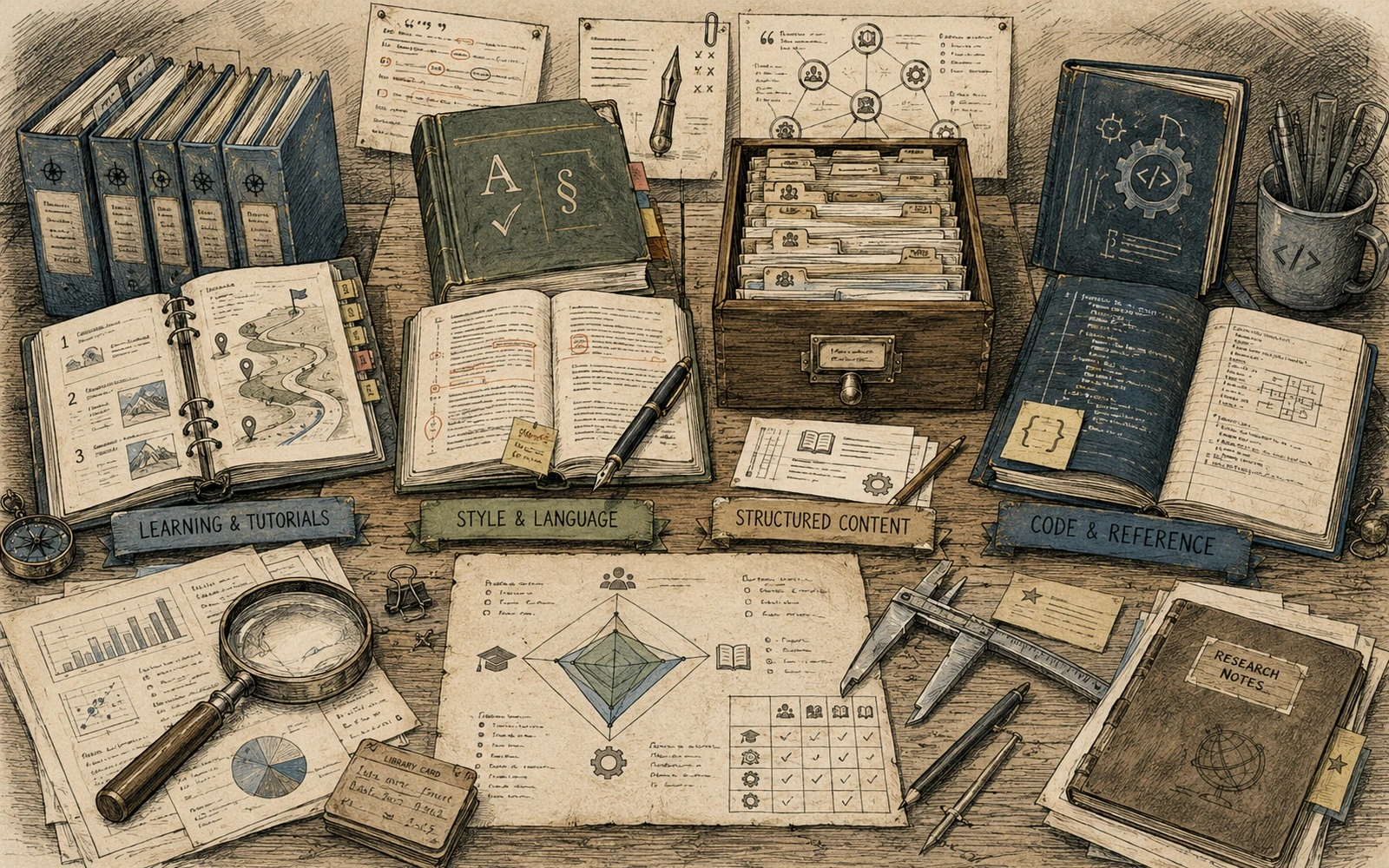
Microsoft, Google, IBM, and Apple have converged on four distinct documentation models. Microsoft built the broadest platform around docs and learning; Google offers the strongest open editorial reference; IBM formalizes quality and content modeling; Apple keeps developer documentation closest to source code and the build toolchain.
We compared the official portals, style guides, contributor guidance, archives, authoring toolchains, search, versioning, accessibility, localization, and machine access. The goal is to identify which model works best as an operating system for documentation and which practices are worth adopting elsewhere.
Method
The study is based on open primary sources and public official documentation from Google, Microsoft, IBM, and Apple. For each company we examined the main portal, style guide, contributor guidance, archive, authoring toolchain, versioning, feedback, accessibility/localization, and machine-search access. All four systems were scored against the same nine criteria on a 0–2 scale. Snapshot date: August 14, 2026.
Who is strongest across the full system
Microsoft leads with 17/18, followed by IBM with 15, Google with 14, and Apple with 13. Microsoft gains its edge from the combination of portal architecture, versioning, learning content, authoring workflow, and official machine access to its knowledge base. Nine criteria are scored 0–2; maximum 18.
What was scored
0 = not found in the official materials reviewed · 1 = partial or product-specific · 2 = clear first-class capability
| Criterion | Microsoft | IBM | Apple | |
|---|---|---|---|---|
| Unified portal and navigation | 2 | 1 | 2 | 2 |
| Public style guide | 2 | 2 | 2 | 1 |
| Visible guide maintenance | 2 | 2 | 1 | 1 |
| Tutorial / how-to / reference | 2 | 2 | 2 | 2 |
| Versions and archive | 2 | 1 | 2 | 2 |
| Feedback and participation | 1 | 1 | 1 | 1 |
| Authoring toolchain integration | 2 | 1 | 2 | 2 |
| Accessibility, inclusivity, localization | 2 | 2 | 2 | 2 |
| AI/agent access to docs | 2 | 2 | 1 | 0 |
Scale and measurable signals
The study compares four numerical signals from official sources: the historical MSDN page count, Google Developer Knowledge MCP coverage, IBM Documentation search traffic share, and Apple Documentation Archive size.
| Company | Verifiable scale marker | Source |
|---|---|---|
| Microsoft | MSDN Online already hosted more than 250,000 pages in 1998. | [M5] |
| The 2026 Developer Knowledge MCP reference lists 18 documentation coverage groups/domains. | [G5] | |
| IBM | IBM reports that 80% of IBM Documentation traffic enters through search, which also spans other IBM technical-content sources. | [I8] |
| Apple | The official Documentation Archive contains 5,219 archived documents. | [A2] |
How portals and tooling changed
The TechWriters.org timeline follows key documentation-platform and tooling changes from the 1990s through 2026.
Microsoft Developer Network launches as a dedicated information service for developers. [M5]
MSDN Online passes 250,000 pages, making documentation publishing an infrastructure problem at large scale. [M5]
docs.microsoft.com launches after research with hundreds of developers and IT professionals; Markdown, GitHub contribution, intent-based navigation, and shorter articles enter the model. [M6]
Knowledge Center becomes IBM Documentation, centered on search, a unified entry point, user research, and feedback. [I5]
DocC arrives with Xcode 13 and later becomes open source, combining source comments, Markdown articles, tutorials, and documentation builds. [A4]
Google Style Guide expands accessibility, semantic tables, global-audience writing, paragraph structure, ARIA, and task-oriented guidance. [G2]
The Swift Programming Language moves to DocC; more than 50 pull requests are accepted during conversion and translations use the same publishing pipeline. [A5]
Generative AI, prompts, accessibility, inclusive language, code formatting, and UI wording become routine style-guide topics. [G2]
Microsoft Learn publishes an MCP server for searching and retrieving official documentation from AI tools and agents. [M4]
Google Developer Knowledge MCP exposes machine search across official developer documentation and lists 18 covered product/domain groups. [G5]
Official CICS documentation adds AI-generated search results for search queries of three words or more. [I7]
How the style guides themselves changed
Google and Microsoft changelogs show task design, accessibility, global writing, code markup, and AI rules becoming routine authoring concerns.
| Year | Company | What changed for the writer | Source |
|---|---|---|---|
| 2021 | Task context, imperative procedures, avoiding empty “run the following command” phrasing, global audience, and timeless documentation. | [G2] | |
| 2021 | Microsoft | Inclusive language becomes an explicit guide concern alongside bias-free terminology. | [M1] |
| 2022 | Accessibility reaches tables, UI, punctuation, cognitive load, and Markdown-aware authoring guidance. | [G2] | |
| 2022 | Microsoft | UI wording and pronoun guidance expands, including pronouns in AI-generated content. | [M1] |
| 2023 | Paragraph structure, ARIA, global language, and information that works without images or animation become explicit. | [G2] | |
| 2023 | Microsoft | Accessibility language becomes more nuanced, including people-first/identity-first wording and screen-reader-friendly tables. | [M1] |
| 2024 | Generative AI enters the word list while timeless docs, alt text, captions, and terminology precision are strengthened. | [G2] | |
| 2024 | Microsoft | Prompt/prompting guidance appears together with dedicated AI-prompt writing resources. | [M1] |
| 2025 | Prescriptive documentation is added and task design, links, code, and accessibility continue to converge. | [G2] | |
| 2025 | Microsoft | Updates cover code formatting, accessible minus signs, identity language, and tone. | [M1] |
| 2026 | Global-audience guidance is restructured; UI context, code formatting, and AI terminology are updated. | [G2] | |
| 2026 | Microsoft | Screen reader, alt text, AI prompts, emoji accessibility, tooltips, and UI wording become routine guide maintenance. | [M1] |
What changed for the technical writer
From the 1990s through 2026, the work expanded from manuals and HTML pages to knowledge systems used in browsers, IDEs, search, and AI interfaces.
| Period | Primary artifact | Typical tooling | Editorial focus | Delivery | Writer role |
|---|---|---|---|---|---|
| 1990–2015 | Manual / HTML page | Word, CMS, XML, specialized publishing | Completeness, consistency, reference | Web + PDF | Specialist author |
| 2016–2020 | Task-oriented portal | CMS + Git/Markdown | Searchability, task success, concise web writing, IA | Central portal | Content owner in product workflow |
| 2021–2024 | Structured knowledge close to code | Git, Markdown, DITA, DocC, CI | Semantics, reuse, accessibility, localization | Portal + IDE + generated reference | Information architect + automation partner |
| 2025–2026 | Knowledge source for people and AI | Source + metadata + schemas + retrieval interfaces | Grounding, retrievability, fact quality, machine consumption | Portal + IDE + search + MCP/AI | Editor, system designer, verifier |
The decisive shift is ownership of the knowledge system: writing still matters, but the role increasingly includes structure, verification, maintenance, retrieval, and integration with development.
What to borrow from each company
Each company is worth studying for a different reason. The useful move is not to copy a portal wholesale, but to take the practices that solve a concrete editorial or engineering problem.
| Put conditions before instructions | Readers learn whether a step applies before they act. |
|---|---|
| Do not use color or position as the only meaning | Accessibility rules also improve scanning and localization. |
| Write for a global audience | Avoid idioms and culture-specific wording that breaks translation. |
| Put clarity ahead of mechanical guide compliance | Google allows departures from guidance when the result is clearer for the reader. |
Microsoft
[M2]| Use bigger ideas and fewer words | Conciseness is treated as experience design rather than cosmetic editing. |
|---|---|
| Remove weak `you can` phrasing | Direct instructions scan faster in task-oriented documentation. |
| Keep the guide alive | The changelog is actively updated for AI prompts, accessibility, terminology, and UI wording. |
| Separate feedback from editing | Learn combines standard feedback with GitHub-based editing where sources are public. |
IBM
[I2]| Review explicit quality characteristics | IBM uses task orientation, accuracy, completeness, clarity, style, organization, and retrievability, turning review into a check of concrete properties. |
|---|---|
| Model content types explicitly | How-to, API reference, troubleshooting, release notes, and more belong to a formal model. |
| Reuse semantically | DITA/Markdown references help keep repeated content synchronized. |
| Treat the writer as user advocate | Quality begins with user goals rather than publication volume. |
Apple
[A3]| Keep docs close to source code | DocC combines source comments with Markdown articles, assets, and API reference. |
|---|---|
| Make tutorials first-class | Guided learning uses the same documentation toolchain as reference. |
| Build docs inside the developer workflow | Xcode and DocC reduce the distance between implementation, API, and explanation. |
| Treat words as interface design | Tone and wording are part of user-experience quality. |
Official sources
The evidence base consists of primary official materials from Google, Microsoft, IBM, and Apple.
Final verdict: clear winners for different jobs
| Company | Strongest area | Research conclusion |
|---|---|---|
| Microsoft | Infrastructure | Documentation, learning, versions, feedback, and AI access form the most integrated system. |
| Editorial guidance | The most transparent public style guide, with a living changelog, accessibility rules, and global-writing guidance. | |
| IBM | Quality model | The most systematic formalization of quality, content types, findability, and reuse. |
| Apple | Code integration | DocC connects API reference, articles, tutorials, and source code more tightly than the other systems. |
Our overall winner is Microsoft. It has moved furthest from a documentation website toward a documentation platform: one entry point, learning content, versioning, feedback, contribution workflows, and now MCP access for AI tools.
Google is our pick for the best daily editorial reference. Its guide turns vague advice about clarity into concrete decisions about task context, procedures, prescriptive documentation, global audiences, accessibility, UI text, and code formatting.
IBM is the most underrated system in the comparison. It formalizes the questions documentation teams often leave subjective: quality, content types, retrievability, feedback, metrics, and maintenance. Mature teams can use this as an operating model, not just a writing guide.
Apple points most clearly toward the future of developer documentation. DocC makes API reference, conceptual articles, and tutorials part of the same source-adjacent workflow, linkable by symbols and deliverable in both IDE and web contexts.
If we must pick one documentation system overall, Microsoft wins: none of the other three combines portal infrastructure, learning, versions, feedback, and official machine access as completely. Google wins the day-to-day editor’s contest with the most useful public style guide. IBM wins when a team needs a rigorous quality and content-model framework. Apple offers the clearest direction for developer documentation that lives beside source code and ships through the developer toolchain. The strongest modern documentation program borrows from all four.